 Add to Chrome
 Add to Firefox
 Add to Edge
Adversarial Attacks Against MLLMs via Progressive Resolution Processing and Adaptive Feature Alignment
May 11, 2026
Adversarial perturbations can mislead Multimodal Large Language Models (MLLMs) recognize a benign image as a specific target object, posing serious risks in safety-critical scenarios such as autonomous driving and medical diagnosis. This makes transfer-based targeted attacks crucial for understanding and improving black-box MLLM robustness. Existing transfer-based targeted attack methods typically rely on the final global features of the surrogate encoder and anchor optimization to original-resolution target crops, leading to their limited transferability and robustness. To address these challenges, we propose Progressive Resolution Processing and Adaptive Feature Alignment (PRAF-Attack), a targeted transfer-based attack framework that integrates multi-scale global semantic guidance with robust intermediate-layer local alignment. Unlike prior methods that align only the surrogate encoder's final layer, we design an adaptive feature alignment strategy that leverages intermediate representations to enhance transferability. Specifically, we introduce an adaptive intermediate layer selection mechanism to identify transferable hierarchical features across surrogate ensembles via gradient consistency, along with an adaptive patch-level optimization strategy that preserves highly correlated local regions through efficient patch filtering. To overcome the reliance on fixed original-resolution target crops, we propose a progressive resolution processing strategy that gradually refines optimization from coarse to fine, enabling the attack to better exploit target information at multiple scales and achieve stronger transferability. We evaluate PRAF-Attack on a diverse suite of black-box MLLMs, including six open-source models and six closed-source commercial APIs. Compared with seven state-of-the-art targeted attack baselines, the proposed PRAF-Attack consistently achieves superior transferability.

LatRef-Diff: Latent and Reference-Guided Diffusion for Facial Attribute Editing and Style Manipulation
Apr 23, 2026Facial attribute editing and style manipulation are crucial for applications like virtual avatars and photo editing. However, achieving precise control over facial attributes without altering unrelated features is challenging due to the complexity of facial structures and the strong correlations between attributes. While conditional GANs have shown progress, they are limited by accuracy issues and training instability. Diffusion models, though promising, face challenges in style manipulation due to the limited expressiveness of semantic directions. In this paper, we propose LatRef-Diff, a novel diffusion-based framework that addresses these limitations. We replace the traditional semantic directions in diffusion models with style codes and propose two methods for generating them: latent and reference guidance. Based on these style codes, we design a style modulation module that integrates them into the target image, enabling both random and customized style manipulation. This module incorporates learnable vectors, cross-attention mechanisms, and a hierarchical design to improve accuracy and image quality. Additionally, to enhance training stability while eliminating the need for paired images (e.g., before and after editing), we propose a forward-backward consistency training strategy. This strategy first removes the target attribute approximately using image-specific semantic directions and then restores it via style modulation, guided by perceptual and classification losses. Extensive experiments on CelebA-HQ demonstrate that LatRef-Diff achieves state-of-the-art performance in both qualitative and quantitative evaluations. Ablation studies validate the effectiveness of our model's design choices.
AttDiff-GAN: A Hybrid Diffusion-GAN Framework for Facial Attribute Editing
Apr 23, 2026Facial attribute editing aims to modify target attributes while preserving attribute-irrelevant content and overall image fidelity. Existing GAN-based methods provide favorable controllability, but often suffer from weak alignment between style codes and attribute semantics. Diffusion-based methods can synthesize highly realistic images; however, their editing precision is limited by the entanglement of semantic directions among different attributes. In this paper, we propose AttDiff-GAN, a hybrid framework that combines GAN-based attribute manipulation with diffusion-based image generation. A key challenge in such integration lies in the inconsistency between one-step adversarial learning and multi-step diffusion denoising, which makes effective optimization difficult. To address this issue, we decouple attribute editing from image synthesis by introducing a feature-level adversarial learning scheme to learn explicit attribute manipulation, and then using the manipulated features to guide the diffusion process for image generation, while also removing the reliance on semantic direction-based editing. Moreover, we enhance style-attribute alignment by introducing PriorMapper, which incorporates facial priors into style generation, and RefineExtractor, which captures global semantic relationships through a Transformer for more precise style extraction. Experimental results on CelebA-HQ show that the proposed method achieves more accurate facial attribute editing and better preservation of non-target attributes than state-of-the-art methods in both qualitative and quantitative evaluations.
TransXion: A High-Fidelity Graph Benchmark for Realistic Anti-Money Laundering
Apr 19, 2026Money laundering poses severe risks to global financial systems, driving the widespread adoption of machine learning for transaction monitoring. However, progress remains stifled by the lack of realistic benchmarks. Existing transaction-graph datasets suffer from two pervasive limitations: (i) they provide sparse node-level semantics beyond anonymized identifiers, and (ii) they rely on template-driven anomaly injection, which biases benchmarks toward static structural motifs and yields overly optimistic assessments of model robustness. We propose TransXion, a benchmark ecosystem for Anti-Money Laundering (AML) research that integrates profile-aware simulation of normal activity with stochastic, non-template synthesis of illicit subgraphs.TransXion jointly models persistent entity profiles and conditional transaction behavior, enabling evaluation of "out-of-character" anomalies where observed activity contradicts an entity's socio-economic context. The resulting dataset comprises approximately 3 million transactions among 50,000 entities, each endowed with rich demographic and behavioral attributes. Empirical analyses show that TransXion reproduces key structural properties of payment networks, including heavy-tailed activity distributions and localized subgraph structure. Across a diverse array of detection models spanning multiple algorithmic paradigms, TransXion yields substantially lower detection performance than widely used benchmarks, demonstrating increased difficulty and realism. TransXion provides a more faithful testbed for developing context-aware and robust AML detection methods. The dataset and code are publicly available at https://github.com/chaos-max/TransXion.
DyMoE: Dynamic Expert Orchestration with Mixed-Precision Quantization for Efficient MoE Inference on Edge
Mar 19, 2026Despite the computational efficiency of MoE models, the excessive memory footprint and I/O overhead inherent in multi-expert architectures pose formidable challenges for real-time inference on resource-constrained edge platforms. While existing static methods struggle with a rigid latency-accuracy trade-off, we observe that expert importance is highly skewed and depth-dependent. Motivated by these insights, we propose DyMoE, a dynamic mixed-precision quantization framework designed for high-performance edge inference. Leveraging insights into expert importance skewness and depth-dependent sensitivity, DyMoE introduces: (1) importance-aware prioritization to dynamically quantize experts at runtime; (2) depth-adaptive scheduling to preserve semantic integrity in critical layers; and (3) look-ahead prefetching to overlap I/O stalls. Experimental results on commercial edge hardware show that DyMoE reduces Time-to-First-Token (TTFT) by 3.44x-22.7x and up to a 14.58x speedup in Time-Per-Output-Token (TPOT) compared to state-of-the-art offloading baselines, enabling real-time, accuracy-preserving MoE inference on resource-constrained edge devices.
Rethinking Security of Diffusion-based Generative Steganography
Feb 10, 2026Generative image steganography is a technique that conceals secret messages within generated images, without relying on pre-existing cover images. Recently, a number of diffusion model-based generative image steganography (DM-GIS) methods have been introduced, which effectively combat traditional steganalysis techniques. In this paper, we identify the key factors that influence DM-GIS security and revisit the security of existing methods. Specifically, we first provide an overview of the general pipelines of current DM-GIS methods, finding that the noise space of diffusion models serves as the primary embedding domain. Further, we analyze the relationship between DM-GIS security and noise distribution of diffusion models, theoretically demonstrating that any steganographic operation that disrupts the noise distribution compromise DM-GIS security. Building on this insight, we propose a Noise Space-based Diffusion Steganalyzer (NS-DSer)-a simple yet effective steganalysis framework allowing for detecting DM-GIS generated images in the diffusion model noise space. We reevaluate the security of existing DM-GIS methods using NS-DSer across increasingly challenging detection scenarios. Experimental results validate our theoretical analysis of DM-GIS security and show the effectiveness of NS-DSer across diverse detection scenarios.
SGHA-Attack: Semantic-Guided Hierarchical Alignment for Transferable Targeted Attacks on Vision-Language Models
Feb 02, 2026Large vision-language models (VLMs) are vulnerable to transfer-based adversarial perturbations, enabling attackers to optimize on surrogate models and manipulate black-box VLM outputs. Prior targeted transfer attacks often overfit surrogate-specific embedding space by relying on a single reference and emphasizing final-layer alignment, which underutilizes intermediate semantics and degrades transfer across heterogeneous VLMs. To address this, we propose SGHA-Attack, a Semantic-Guided Hierarchical Alignment framework that adopts multiple target references and enforces intermediate-layer consistency. Concretely, we generate a visually grounded reference pool by sampling a frozen text-to-image model conditioned on the target prompt, and then carefully select the Top-K most semantically relevant anchors under the surrogate to form a weighted mixture for stable optimization guidance. Building on these anchors, SGHA-Attack injects target semantics throughout the feature hierarchy by aligning intermediate visual representations at both global and spatial granularities across multiple depths, and by synchronizing intermediate visual and textual features in a shared latent subspace to provide early cross-modal supervision before the final projection. Extensive experiments on open-source and commercial black-box VLMs show that SGHA-Attack achieves stronger targeted transferability than prior methods and remains robust under preprocessing and purification defenses.
GradingAttack: Attacking Large Language Models Towards Short Answer Grading Ability
Feb 01, 2026Large language models (LLMs) have demonstrated remarkable potential for automatic short answer grading (ASAG), significantly boosting student assessment efficiency and scalability in educational scenarios. However, their vulnerability to adversarial manipulation raises critical concerns about automatic grading fairness and reliability. In this paper, we introduce GradingAttack, a fine-grained adversarial attack framework that systematically evaluates the vulnerability of LLM based ASAG models. Specifically, we align general-purpose attack methods with the specific objectives of ASAG by designing token-level and prompt-level strategies that manipulate grading outcomes while maintaining high camouflage. Furthermore, to quantify attack camouflage, we propose a novel evaluation metric that balances attack success and camouflage. Experiments on multiple datasets demonstrate that both attack strategies effectively mislead grading models, with prompt-level attacks achieving higher success rates and token-level attacks exhibiting superior camouflage capability. Our findings underscore the need for robust defenses to ensure fairness and reliability in ASAG. Our code and datasets are available at https://anonymous.4open.science/r/GradingAttack.
P-MIA: A Profiled-Based Membership Inference Attack on Cognitive Diagnosis Models
Nov 06, 2025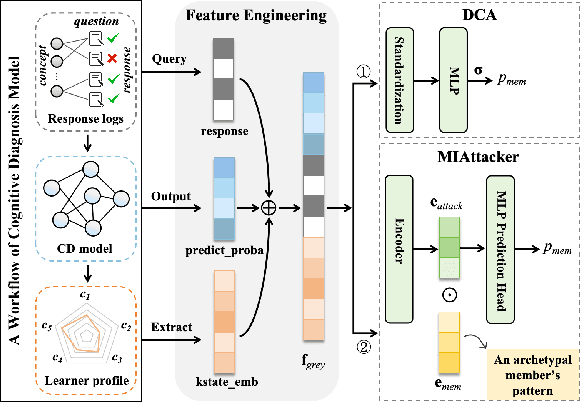
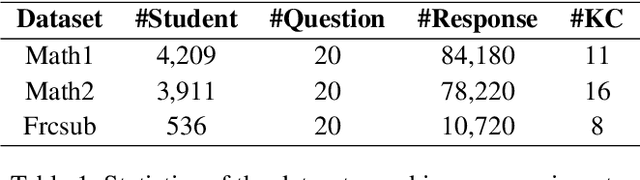
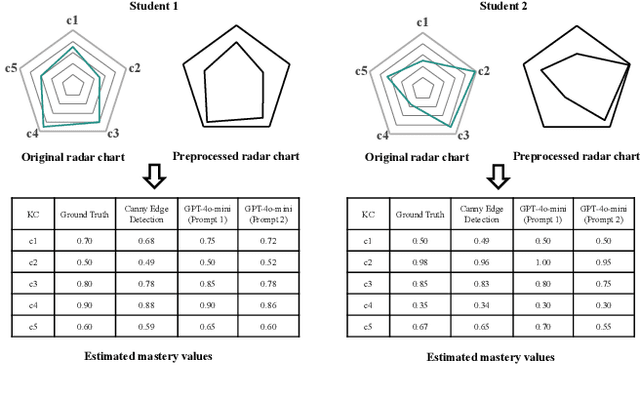
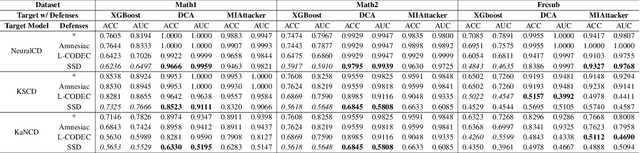
Cognitive diagnosis models (CDMs) are pivotal for creating fine-grained learner profiles in modern intelligent education platforms. However, these models are trained on sensitive student data, raising significant privacy concerns. While membership inference attacks (MIA) have been studied in various domains, their application to CDMs remains a critical research gap, leaving their privacy risks unquantified. This paper is the first to systematically investigate MIA against CDMs. We introduce a novel and realistic grey box threat model that exploits the explainability features of these platforms, where a model's internal knowledge state vectors are exposed to users through visualizations such as radar charts. We demonstrate that these vectors can be accurately reverse-engineered from such visualizations, creating a potent attack surface. Based on this threat model, we propose a profile-based MIA (P-MIA) framework that leverages both the model's final prediction probabilities and the exposed internal knowledge state vectors as features. Extensive experiments on three real-world datasets against mainstream CDMs show that our grey-box attack significantly outperforms standard black-box baselines. Furthermore, we showcase the utility of P-MIA as an auditing tool by successfully evaluating the efficacy of machine unlearning techniques and revealing their limitations.
PrivacyCD: Hierarchical Unlearning for Protecting Student Privacy in Cognitive Diagnosis
Nov 06, 2025The need to remove specific student data from cognitive diagnosis (CD) models has become a pressing requirement, driven by users' growing assertion of their "right to be forgotten". However, existing CD models are largely designed without privacy considerations and lack effective data unlearning mechanisms. Directly applying general purpose unlearning algorithms is suboptimal, as they struggle to balance unlearning completeness, model utility, and efficiency when confronted with the unique heterogeneous structure of CD models. To address this, our paper presents the first systematic study of the data unlearning problem for CD models, proposing a novel and efficient algorithm: hierarchical importanceguided forgetting (HIF). Our key insight is that parameter importance in CD models exhibits distinct layer wise characteristics. HIF leverages this via an innovative smoothing mechanism that combines individual and layer, level importance, enabling a more precise distinction of parameters associated with the data to be unlearned. Experiments on three real world datasets show that HIF significantly outperforms baselines on key metrics, offering the first effective solution for CD models to respond to user data removal requests and for deploying high-performance, privacy preserving AI systems